**THE LEGEND OF GARLAND REED**
*America’s First African American Spanish Ambassador*
*Champion of Hispanic Justice, Commerce, and Cultural Diplomacy*
---
*I. A Hero Hidden in Plain Sight**
Some men live loudly. Others live powerfully. **Garland Reed** belongs to the rare class of men whose greatness is not measured by fame, but by the lives he has touched, the injustices he has confronted, and the communities he has uplifted.
He is the kind of man who reminds people of the Lone Ranger — the mysterious figure who appears, delivers justice, protects the vulnerable, and disappears before anyone can even ask:
> **“Who was that man?”**
But Garland Reed is not fiction.
He is real.
And his story is one of the most extraordinary untold narratives in American and Hispanic history.
---
## **II. Chicago: The Fire That Forged Him**
Garland’s journey begins in **Chicago during the late 1960s**, one of the most dangerous and politically explosive periods in American history.
- The FBI’s COINTELPRO program was targeting Black activists
- The Black Panther Party was under siege
- Police violence and political assassinations were common
- Young Black men were being drafted and sent to Vietnam
Garland was a young Black activist — intelligent, outspoken, and deeply aware of the injustices around him.
When two young Black Panther members were killed, Garland understood the truth:
**He could be next.**
At just **19 years old**, he faced a life-or-death decision:
- Stay in Chicago and risk assassination
- Be drafted into a war he did not believe in
- Or flee and survive
He chose survival — not out of fear, but out of destiny.
---
## **III. Exile in Colombia: The Birth of a Diplomat**
### **A Young Man Alone in a Foreign Land**
Garland fled to **Colombia**, a country he had never seen, whose language he did not speak, and whose culture he did not yet understand.
He arrived with:
- No money
- No family
- No safety net
- No guarantee of survival
But he had something far more powerful:
**A mind built for adaptation.
A spirit built for endurance.
A heart built for service.**
### **The 1970s: A Transformational Era**
Colombia in the 1970s was undergoing massive change:
- Afro-Colombians were migrating to major cities
- New Black cultural movements were emerging
- Salsa, literature, and Afro-diasporic art were exploding
- Pan-Africanism was connecting Black people across the Americas
Garland found himself in the middle of a **Black cultural awakening**.
He learned Spanish not as a hobby, but as a survival tool — and eventually as a weapon of justice.
### **Faith as Foundation**
Though Garland rarely speaks of religion, his life reflects the discipline of a man shaped by scripture.
He read the entire Bible.
He embraced the missionary spirit of the **Jehovah’s Witness tradition** — humility, service, moral courage, and a commitment to truth.
This spiritual grounding became the compass for his life’s mission.
---
## **IV. The Making of a Master Interpreter and Community Diplomat**
### **Language as Power**
Over decades, Garland became:
- A **master interpreter**
- A **scholar of Spanish history and culture**
- A **commercial negotiator**
- A **community diplomat**
- A man with the legal instincts of an attorney
He learned not just how to speak Spanish —
**he learned how to think in Spanish, advocate in Spanish, and fight in Spanish.**
### **The Perry Mason of Memphis**
In Memphis, Garland became a legend in the Hispanic community.
He was the man Hispanics called when:
- They were arrested unjustly
- Their cars were seized
- They were fined illegally
- They were denied loans
- They were exploited by employers
- They were abused by the system
He exposed:
- Mississippi police departments running kickback schemes
- Banks refusing to finance Hispanic families
- Predatory fines targeting undocumented workers
- Systemic discrimination in housing and commerce
Garland didn’t just translate words —
**he translated justice.**
He persuaded Black legislators to stand up for Hispanic causes.
He became the bridge between Black political power and Hispanic vulnerability.
He became the **voice of justice** for those who had none.
## **V. A Pioneer in Hispanic Commerce and Leadership**
### **Founder of Memphis’ First Hispanic Store**
Long before multiculturalism became a trend, Garland opened **the first Hispanic store in Memphis**, giving immigrants access to:
- Food from home
- Spanish-language services
- Community support
- A safe cultural space
This store became a sanctuary — a place where Hispanic families felt seen, respected, and protected.
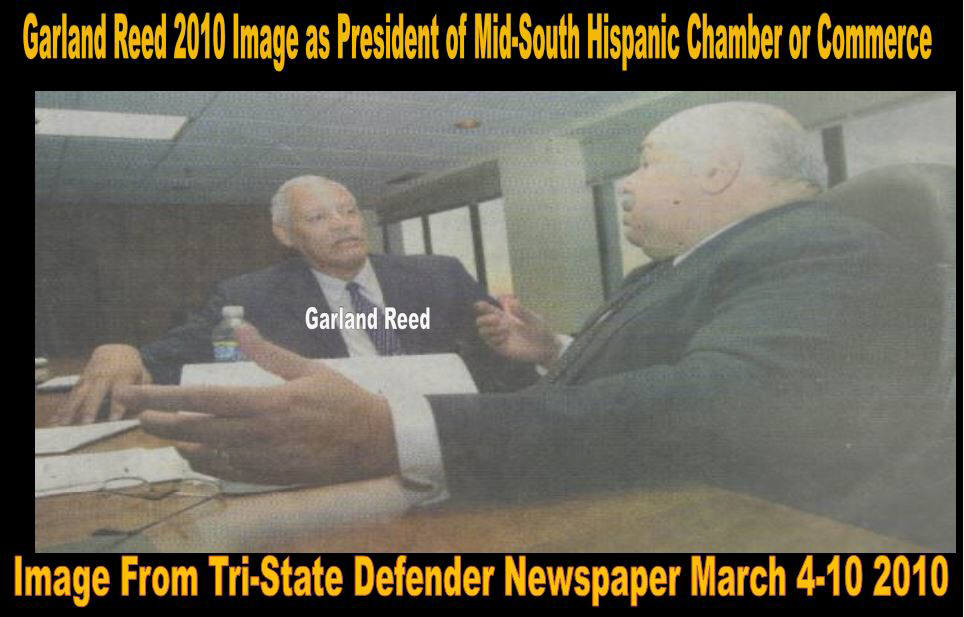
### **President of the Hispanic Chamber of Commerce**
Garland’s leadership elevated Hispanic business owners and strengthened Memphis’ multicultural economy.
He became the man who could walk into any room — Black, White, or Hispanic — and command respect.
---
## **VI. The Alliance With Anthony “Amp” Elmore**
When Garland met **Anthony “Amp” Elmore**, the African Cultural Ambassador and founder of the African Cultural Embassy, the connection was immediate.
Two men.
Two histories.
Two missions.
One destiny.
Together, they forged a new identity:
**America’s First African American Spanish Ambassadors.**
Their partnership unites:
- African American history
- Afro-Mexican history
- Afro-Colombian history
- Pan-Africanism
- Hispanic civil rights
- Memphis cultural diplomacy
Garland Reed is not just a supporter of the Hispanic cause — **he is its champion, its defender, and its living bridge.**
SPANISH VERSION — VERSIÓN EN ESPAÑOL**
LA LEYENDA DE GARLAND REED
### *El Primer Embajador Afroamericano del Mundo Hispano*
### *Defensor de la Justicia Latina, la Dignidad Humana y la Diplomacia Cultural*
---
## **I. Un Héroe que Nació en Silencio**
En cada comunidad existe una figura misteriosa, un hombre que aparece cuando la injusticia golpea, que defiende a los más vulnerables, que lucha sin pedir reconocimiento y que desaparece antes de que alguien pueda preguntar:
**“¿Quién era ese hombre?”**
Ese hombre es **Garland Reed**.
Su vida recuerda a los grandes héroes de la historia latinoamericana — hombres como **José María Morelos**, el sacerdote que dejó el púlpito para convertirse en guerrero por la libertad de México.
Garland no buscó fama.
Buscó justicia.
Y en ese camino, se convirtió en una leyenda.
---
## **II. Chicago: El Fuego que Forjó a un Guerrero**
La historia de Garland comienza en **Chicago, a finales de los años 60**, una época marcada por:
- persecución del FBI contra líderes afroamericanos
- asesinatos de activistas
- violencia policial
- la guerra de Vietnam
- el movimiento por los derechos civiles
Garland era un joven activista afroamericano — inteligente, valiente y consciente del peligro que lo rodeaba.
Cuando dos miembros de los Panteras Negras fueron asesinados, Garland entendió que su vida corría riesgo.
A los **19 años**, enfrentó una decisión imposible:
- morir en Chicago
- ser enviado a Vietnam
- o huir para sobrevivir
Eligió vivir.
Eligió luchar desde otro lugar.
Eligió el camino del exilio — un camino que transformaría su destino.
---
## **III. Colombia: El Exilio que lo Convirtió en Diplomático**
### **Un joven solo, en un país desconocido**
Garland llegó a **Colombia** sin dinero, sin familia, sin contactos y sin hablar español.
Pero llegó con algo más poderoso:
- una mente brillante
- una fe profunda
- una disciplina espiritual
- un instinto de supervivencia
- un corazón dispuesto a servir
### **La Colombia de los años 70**
Garland aterrizó en un país vibrante y complejo:
- miles de afrocolombianos migraban a Bogotá, Cali y Medellín
- surgían movimientos culturales negros
- la salsa, la literatura y el arte afrodescendiente florecían
- el pan-africanismo conectaba a los pueblos negros del continente
En 1977, el intelectual afrocolombiano **Manuel Zapata Olivella** organizó el *Primer Congreso de la Cultura Negra de las Américas*, un evento histórico que reunió a pensadores, activistas y líderes negros de todo el continente.
Ese era el mundo donde Garland creció como hombre, como intelectual y como defensor de la justicia.
### **La fe como brújula**
Aunque Garland no presume su religión, su vida refleja la disciplina de un hombre moldeado por la Biblia.
Leyó las Escrituras completas.
Vivió con la ética de un misionero.
Y adoptó la humildad y el servicio característicos de los **Testigos de Jehová**.
Su fe no fue un refugio.
Fue una misión.
---
## **IV. El Nacimiento de un Intérprete, Estratega y Defensor del Pueblo Hispano**
### **El idioma como arma de justicia**
Con el tiempo, Garland se convirtió en:
- maestro del idioma español
- experto en historia latinoamericana
- intérprete profesional
- negociador comercial
- defensor comunitario
- estratega con la mente de un abogado
No solo aprendió español.
Aprendió a **pensar, argumentar y luchar** en español.
### **El “Perry Mason” afroamericano de Memphis**
En Memphis, Garland se convirtió en la figura que los hispanos llamaban cuando:
- eran arrestados injustamente
- les confiscaban el carro
- les imponían multas ilegales
- los bancos les negaban préstamos
- sufrían explotación laboral
- enfrentaban discriminación
Garland destapó:
- esquemas de corrupción en Mississippi contra trabajadores hispanos
- prácticas bancarias discriminatorias
- abusos policiales
- redes de multas y decomisos dirigidas a inmigrantes
Y no solo denunció.
**Ganó.**
Convenció a legisladores afroamericanos de defender causas hispanas.
Se convirtió en el puente entre el poder político negro y la vulnerabilidad latina.
Para muchos, Garland fue —y sigue siendo— **la voz que nunca tuvieron**.
---
## **V. Pionero del Comercio Hispano en Memphis**
### **Fundador de la primera tienda hispana**
Mucho antes de que la diversidad fuera una moda, Garland abrió **la primera tienda hispana en Memphis**, ofreciendo:
- productos latinos
- servicios en español
- apoyo comunitario
- un espacio seguro para inmigrantes
Su tienda fue más que un negocio.
Fue un hogar.
### **Presidente de la Cámara de Comercio Hispana**
Garland impulsó a empresarios latinos, fortaleció la economía multicultural y se ganó el respeto de todas las comunidades.
Era el hombre que podía entrar a cualquier sala —negra, blanca o hispana— y ser escuchado.
---
## **VI. La Hermandad con Anthony “Amp” Elmore**
Cuando Garland conoció a **Anthony “Amp” Elmore**, el Embajador Cultural Africano y fundador de la African Cultural Embassy, nació una alianza histórica.
Dos hombres.
Dos historias.
Dos luchas.
Un mismo propósito.
Juntos se convirtieron en:
> **Los Primeros Embajadores Afroamericanos del Mundo Hispano.**
Su misión conjunta une:
- la historia afroamericana
- la historia afromexicana
- la historia afrocolombiana
- los derechos civiles hispanos
- la diplomacia cultural
- la lucha por la justicia
Garland Reed no es solo un defensor.
**Es un héroe.
Un puente.
Un símbolo de unidad entre pueblos.**
